All 1000 pieces are here. Each of the ten traits can be used as a filter and the filters can be combined, for example a monochrome with radial symmetry, or a solid fill on a dark background. Clicking a piece loads it at the top of the page.
all 1,000
The pegboard
One peg for each piece
Every mint has a peg here, painted with its own background and fill, so the board is also a map of the edition's colour. Click a peg and the piece appears beside the board; hover to preview it. The piece you are looking at is marked with a ring. The buttons rearrange the pegs by number, or grouped by palette, layout, form or symmetry, and you can watch them move to their new places.
Arrange
Showroom
Showroom
How it works
How it works
All of the pieces are made by the same program. It reads a seed, places the pegs, decides the route of the string, and then draws the string as the tight path it would take around those pegs. Nothing is drawn by hand, and the program doesn't change between pieces, only the seed does. The four images below show the piece that is currently at the top of the page, stopped at each stage.
1
The seed and the pegs
The seed is 64 hexadecimal characters, which on a blockchain would be the transaction hash. Here each mint number is turned into a seed, and the seed feeds a small deterministic random generator, so the same seed gives the same piece on any computer. Its first number decides the tier, the next ones the palette and the layout of the pegs, and after that the size of the pegs, whether they vary, and how much margin the composition keeps.
2
The route
The string visits the pegs in an order: shuffled, nearest first, or in an orbit, a snake, a spiral, a zigzag or a wander. Not every peg has to be used. At each peg the string turns clockwise or counterclockwise. In the diagram a filled dot is a clockwise turn, a hollow dot a counterclockwise one, and the ring marks where the string starts.
3
The string
The string is drawn as straight tangent lines and circular arcs, which is what a real string does when it is pulled tight. Between two pegs that turn the same way it takes the outer tangent, and between two that turn opposite ways it takes the inner tangent and crosses over. It never passes through a peg, never skims one, and never goes slack. Getting this right in every case took longer than anything else in the project.
4
Fill, colour and texture
If the string encloses an area, that area can be filled, and the Form trait says how. Some pieces are built from half or a wedge of the field and then mirrored or rotated. Pieces above Common get one ornament, and every piece gets a texture. The ten traits are listed below, and the values that carry an artist's name are explained in the lineage that follows. When a piece loads, the string draws itself around the pegs, and clicking the piece runs its mechanism: most strings travel as belts with the pegs turning like pulleys, some carry a knot or a light, and a few unwind and wrap again. The Motion button switches to the wrap alone, or to stills.
The ten traits
Every piece shows these ten, and each one is a filter in the edition above.
Tier
Common, Uncommon, Rare or Legendary, in the fixed counts of 840, 100, 50 and 10. The rarer tiers are the calmer ones, not the busier ones.
Palette
One of 87 named palettes. Each is a ground, a fill, a line and a disc colour that have passed the contrast and harmony checks.
Family
Light, Deep, Monochrome, Albers, Le Corbusier, Pop or Field, which groups the palettes by kind. Monochromes are kept to about one piece in twenty.
Form
Line, Solid, Two-tone, Film, Klee, Matisse or Herrera: what happens to the area the string encloses.
Layout
Grid, Jittered, Lattice, Ring, Spiral, Sunflower, Scatter, Solar, Constellation, Molnár or Malevich: where the pegs stand.
Symmetry
None, Mirror, af Klint, or Radial with two to six folds.
Pegs
Holes, Discs, Middle, Delaunay, Noland, Kelly, Kandinsky, Ink, Hollow, Accent or Accented: how the pegs are drawn.
Ornament
None, or one of Tracking Rings, Twin String, Halo, Shadow, Echo, Hepworth and Stella.
Texture
Paper, Canvas, Riso, Halftone, Hatch, Anni Albers, Martin or LeWitt: the surface of the fill and the ground.
Mechanism
Belt, Reverse, Spin, Pulse, Runner or Unwind: what the string does when the piece runs. Commons run as belts, with a few that reverse, spin or carry a light. A travelling knot begins at Uncommon, and only Rares and Legendaries unwind and wrap again.
Lineage
Where the traits come from
Each trait value that carries an artist's name takes one idea from that artist's work, and this list goes through them in the order the work was made. Read that way, the edition is a journey through a hundred years of abstract painting, weaving, sculpture, graphic design, colour theory and early computer art, ending with Ringers, which is where Tangents starts. Each row shows a piece from the edition that has the trait, and beside it the artist's work where it is out of copyright. Where it is not, a link leads to where the work can be seen. Clicking one of our pieces loads it at the top of the page.
Delaunay cut her discs into quarters of alternating colour, following Chevreul's law that neighbouring colours change each other. The Delaunay pegs are quartered the same way, in two of the palette's colours, so a field of them is already moving before the string arrives.
Pegs · Delaunay
1914Painting
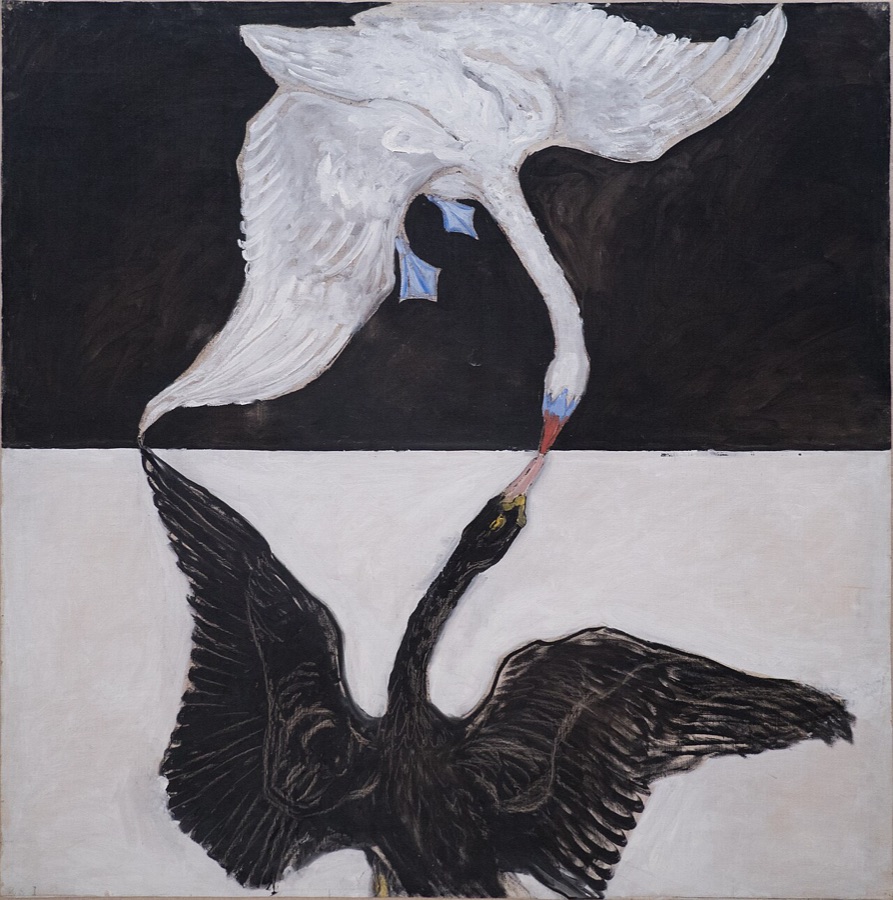
Hilma af Klint, The Swan, No. 1, Group IX/SUW, 1915. Public domain, via Wikimedia Commons.
Hilma af Klint
The Swan, 1914 to 1915
In the Swan paintings two halves mirror each other and take opposite colours, a black swan against a white one. The af Klint symmetry is a mirror whose halves are opposed, in tone or in temperature, with the discs crossed over as well.
Symmetry · af Klint
1915Painting
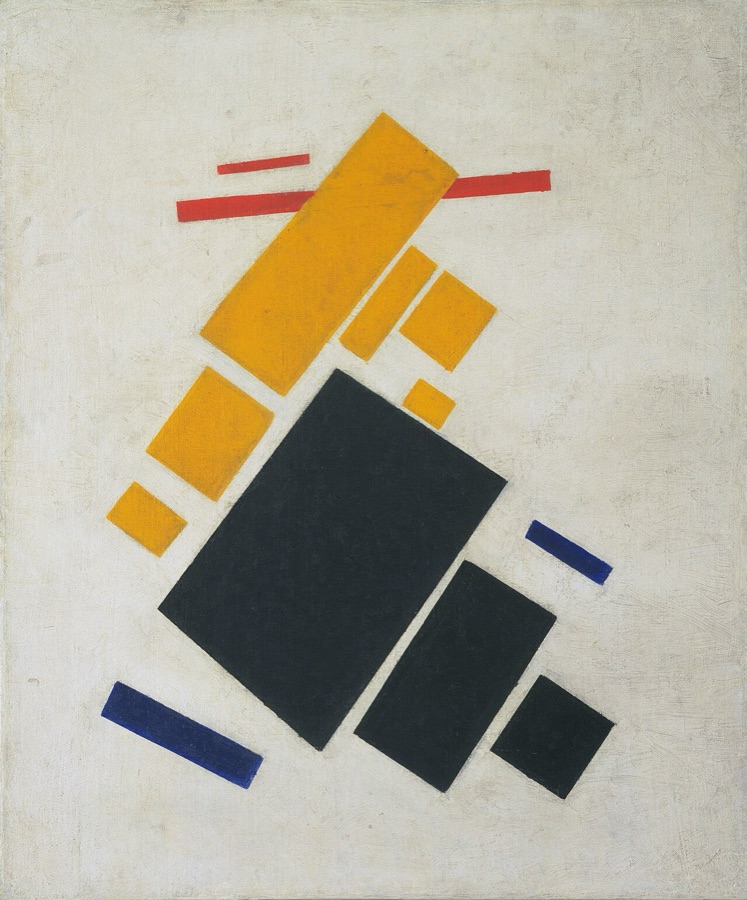
Kazimir Malevich, Suprematist Composition: Airplane Flying, 1915. The Museum of Modern Art, New York. Public domain, via Wikimedia Commons.
Kazimir Malevich
Suprematist Composition: Airplane Flying, 1915
Malevich set a few flat shapes of very different sizes drifting along one diagonal on white. The Malevich layout is that drift: three to six discs, one large and the others much smaller, along a diagonal, each wrapped once and never symmetric.
Layout · Malevich
1919Colour theory
Johannes Itten
The Bauhaus colour course, 1919 to 1923, and The Art of Color, 1961 · Itten on Wikipedia
Itten's contrast of extension, which he took from Goethe, says that a bright colour holds its own on less area than a dull one. The Pop palettes follow it: the brighter the palette, the less of the piece is given to the fill, so a bright piece is usually a line with one accented disc rather than a large flat shape.
Anni Albers made the structure of cloth the picture, plain weave and twill with small variations from thread to thread. The Anni Albers texture lays a fine woven cloth over the fill, with a slight relief and a different weight in every thread, at a pitch small enough to read as material rather than as a pattern.
Texture · Anni Albers
1926Painting
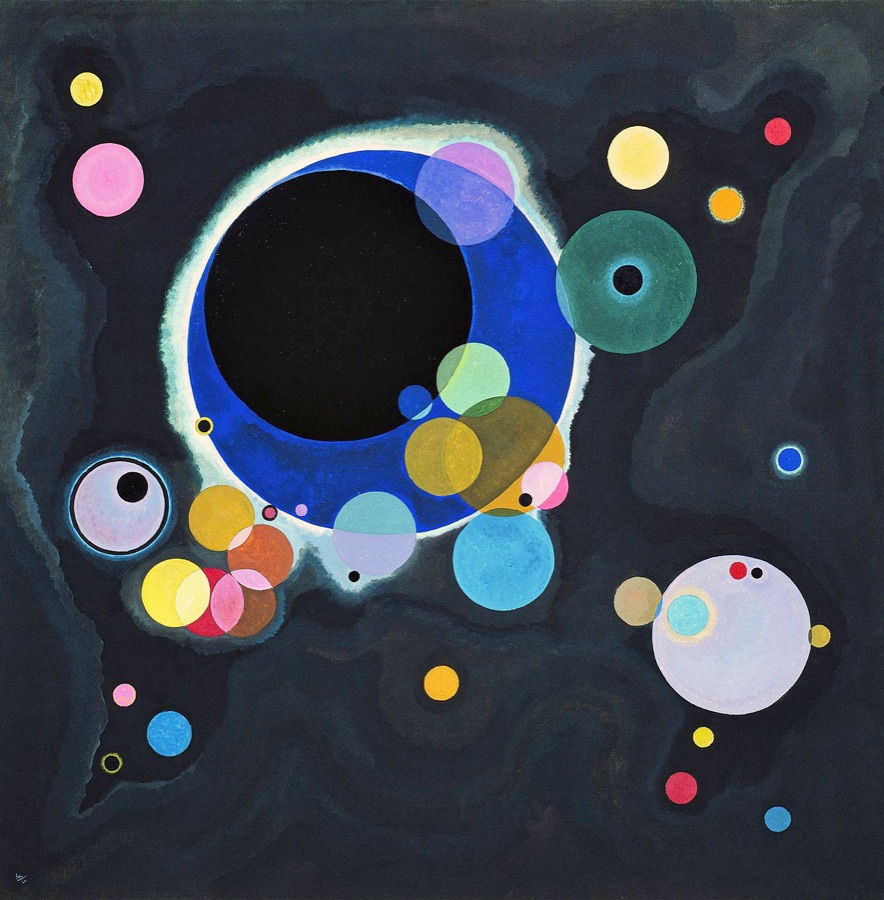
Wassily Kandinsky, Several Circles, 1926. Solomon R. Guggenheim Museum, New York. Public domain, via Wikimedia Commons.
Wassily Kandinsky
Several Circles, 1926
Several Circles is a dark ground with translucent circles that glow where they overlap. The Kandinsky pegs are drawn like that, each disc in its own tone with a soft halo, and only on dark grounds with a few pegs, so every circle keeps its light.
For the wallpaper maker Salubra, Le Corbusier chose 43 colours and arranged them on keyboards, sets that could be combined in a room without a wrong note. The Le Corbusier palettes are eleven combinations taken from those keyboards.
Family · Le Corbusier
1932Painting
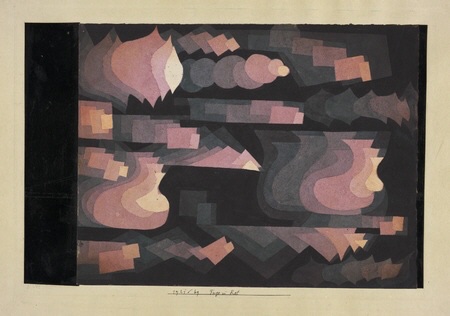
Paul Klee, Fugue in Red, 1921. Public domain, via Wikimedia Commons.
Paul Klee
Fugue in Red, 1921; Polyphony and Ad Parnassum, 1932
Klee borrowed the word polyphony from music for paintings in which layers of colour lie over one another and each layer stays visible. The Klee form deepens the tone every time the string wraps an area again, so a place the string passes three times is three steps darker than a place it passes once.
From 1939 Hepworth strung taut threads across the hollows of her carved forms, so that the space between two surfaces could be seen. The Hepworth ornament is a fan of threads between two arcs of the string, inside the fill and under the discs.
Matisse made his last works with scissors, from paper painted in gouache. The Matisse form cuts the enclosed area from painted paper: one flat colour, an edge that follows the string within the width of the line, a small lift of shadow underneath, and discs cut from the same sheet.
Form · Matisse
1950Colour theory
Josef Albers
Homage to the Square, 1950 to 1976, and Interaction of Color, 1963 · The Albers Foundation
Albers painted the same nested squares for 26 years to study how a colour changes with its neighbours. The Albers palettes are built like those paintings, as steps within one colour climate, and three of his exercises are traits of their own: Middle pegs painted in the exact middle between ground and fill, the Film form, in which overlaps darken like layers of transparent film, and the Echo ornament, nested copies of the shape stepping in tone.
Family · AlbersPegs · MiddleForm · FilmOrnament · Echo
Kelly's Spectrum paintings run the colour wheel across a row of panels, one hue each, with nothing drawn on them. The Kelly pegs take their hues along the route of the string, so the discs go round the wheel in the order the string reaches them. They are kept to fourteen pegs or fewer and to quiet fills, so the spectrum is the loudest thing in the piece.
Noland's targets are concentric rings of colour, each ring a decision about the ones beside it. The Noland pegs are targets, rings of the palette's disc, fill and accent colours from the outside in.
Herrera painted two flat colours divided by one straight edge, and the balance between the two areas was the whole work. The Herrera form fills the enclosed area with two flat colours, one on each side of a straight line through the piece.
In Stella's stripe paintings the bands follow the edge of the canvas inward, so the shape of the support decides the picture. The Stella ornament draws contours inside the fill that follow the string's own edge inward at an even spacing.
Martin drew pencil grids and ruled lines across pale paint, so faint that they are only seen up close. The Martin texture rules the ground with faint lines at that scale, each line a little different in weight, everywhere except across the discs and the string.
Riley's early paintings make a still surface move. In Tangents the string can be a belt made of links in two or three tones. With motion on it travels around the pegs and the pegs it drives turn like pulleys, and in the stills the links simply stand where they are.
Hofmann's manual builds everything from point, line and plane, and its exercises with dots and lines are where Ringers began. A Tangents piece is those three elements and nothing more: the pegs are the points, the string is the line and the fill is the plane.
LeWitt's first wall drawings are lines in four directions, vertical, horizontal and the two diagonals, drawn by other people from his written instructions. The LeWitt texture hatches the fill in those four directions, a different one in each quarter of the piece.
Molnár drew exact grids with a plotter and then disturbed them by a small, measured amount, to find where order stops. The Molnár layout is a regular grid with one dose of disorder, a single peg out of place, a few of them, a drift across the field or a turn, and its string is one circuit through every peg with alternating turns.
Layout · Molnár
1995Colour theory
Matsuda, and Cohen-Or and colleagues
The hue templates, 1995, and Color Harmonization, 2006 · Read the paper
Matsuda's hue templates describe which combinations of hues people read as harmonious, and Cohen-Or's group used them to correct the colours of photographs. Every palette in Tangents has to fit one of those templates at some rotation, and pass checks for contrast and for the distance between fill and ground, before it is admitted.
Ringers is one string wound around a set of pegs, in a thousand variations, and Cherniak has said it grew out of Hofmann's manual. Tangents keeps that premise, one string pulled tight around some pegs, and puts its attention on what the string is not allowed to do and on colour.
The premise
About
About
Tangents started from Ringers by Dmitri Cherniak, which I have been looking at since it came out in 2021. Cherniak's own starting point was Armin Hofmann's Graphic Design Manual from 1965, which builds everything from point, line and plane. I wanted to try the same idea, a string wound around pegs, but quieter and with more attention to colour. The whole system is tangent lines and arcs, the path a real string would take, and the range of shapes that comes out of that one rule still surprises me, bodies, bows, webs, and sometimes something that looks like a face or an animal.
Most of the time went into the string's constraints rather than into features. The string isn't allowed to cut through a disc or to pass very close to one, it can't double back around a very small peg and leave a thin spike across the fill, and it can't cross itself in a way that leaves a tiny sliver of colour. When a route breaks one of these rules the program removes or flips a peg and checks again, and if that doesn't work it draws a new route. All 1000 pieces pass these checks.
The colour system is based on Josef Albers. A piece only has a background, a fill, a line and some discs, so the relationships between those few colours are everything. The Albers palettes are built like his Homage to the Square, as steps within one colour climate, and a few of his exercises are in the pieces directly: fills so close in value to the background that the edge almost disappears, discs painted in the exact middle between background and fill, and overlaps drawn as transparent film.
Traits that come from a specific artist are named after that artist, and the lineage above goes through them in the order the work was made.
There is no roadmap, no token beyond the artwork itself, and no membership or utility. The generator is small and public, so as long as a browser can run JavaScript the piece can be regenerated from its number.
All 1000 pieces already exist and can be browsed above. Minting happens on an external platform rather than on this page, and the link will be in the fact sheet when the sale opens. A mint doesn't generate a new piece, it assigns you one of the unclaimed ones at random, up to ten in one transaction, and there is no allowlist. The contract address will be published in the fact sheet and in the repository before the sale.
Edition
1000 pieces
Price
0.07 ETH each, minted on an external platform
Per transaction
Up to 10 pieces
Network
Robinhood Chain, chain ID 4663. Gas is paid in ETH.